Adaptive AI that transforms its entire UI based on your profession.
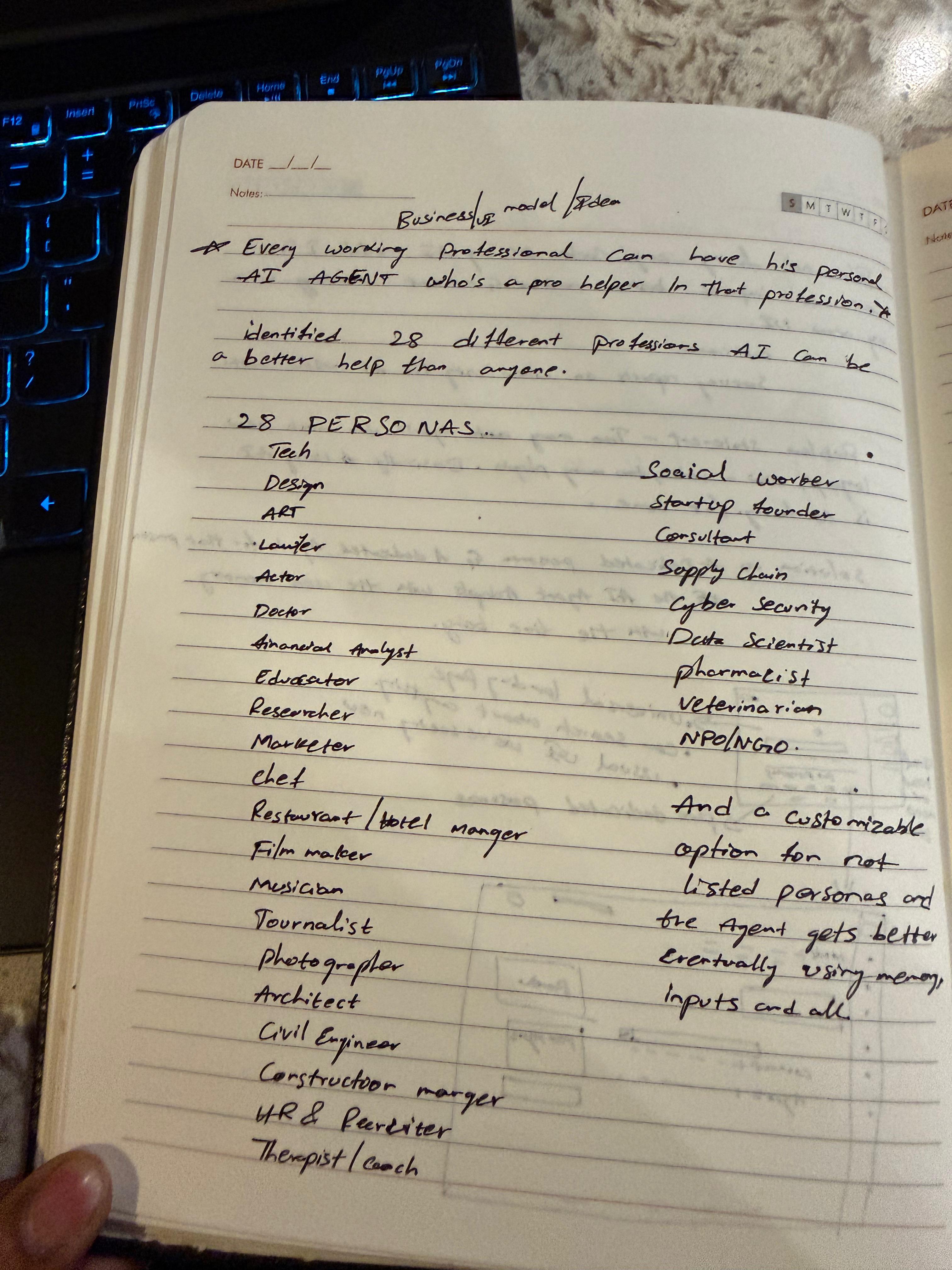
D.AI is not a chatbot skin. It's a profession-aware AI operating system — with curated personas for top professions, each with a unique theme, dedicated agents, contextual integrations, and smart prompt starters. Plus a custom AI-generated persona for any role not listed, powered by D.AI's model layer.
Every element transforms: color, typography, particle effects, search placeholders, agent configurations, tool connections, and chat behavior. The lawyer doesn't see the same interface as the engineer. Because they shouldn't.
∞
Professions Supported
6
Top Profession Categories
12
Professionals Interviewed
✦
Custom AI Persona Generation
The Problem
AI is powerful. But it speaks to no one.
From research across 12 professionals in 6 domains, three problems emerged consistently:
"Too many new agents, too much new language, too many plugins. Basically — using AI is confusing for some."
The Problem
Every model release adds new terminology that professionals can't keep up
"Did you ever get confused with the interface or language?" — Yes, overwhelmingly across all professions
A surgeon opens the same blank box as a comedian — AI doesn't know who you are
The Solution
Profession = Identity — select your profession, entire UI transforms
Integrations = Workflow — each persona connects to profession-specific real tools
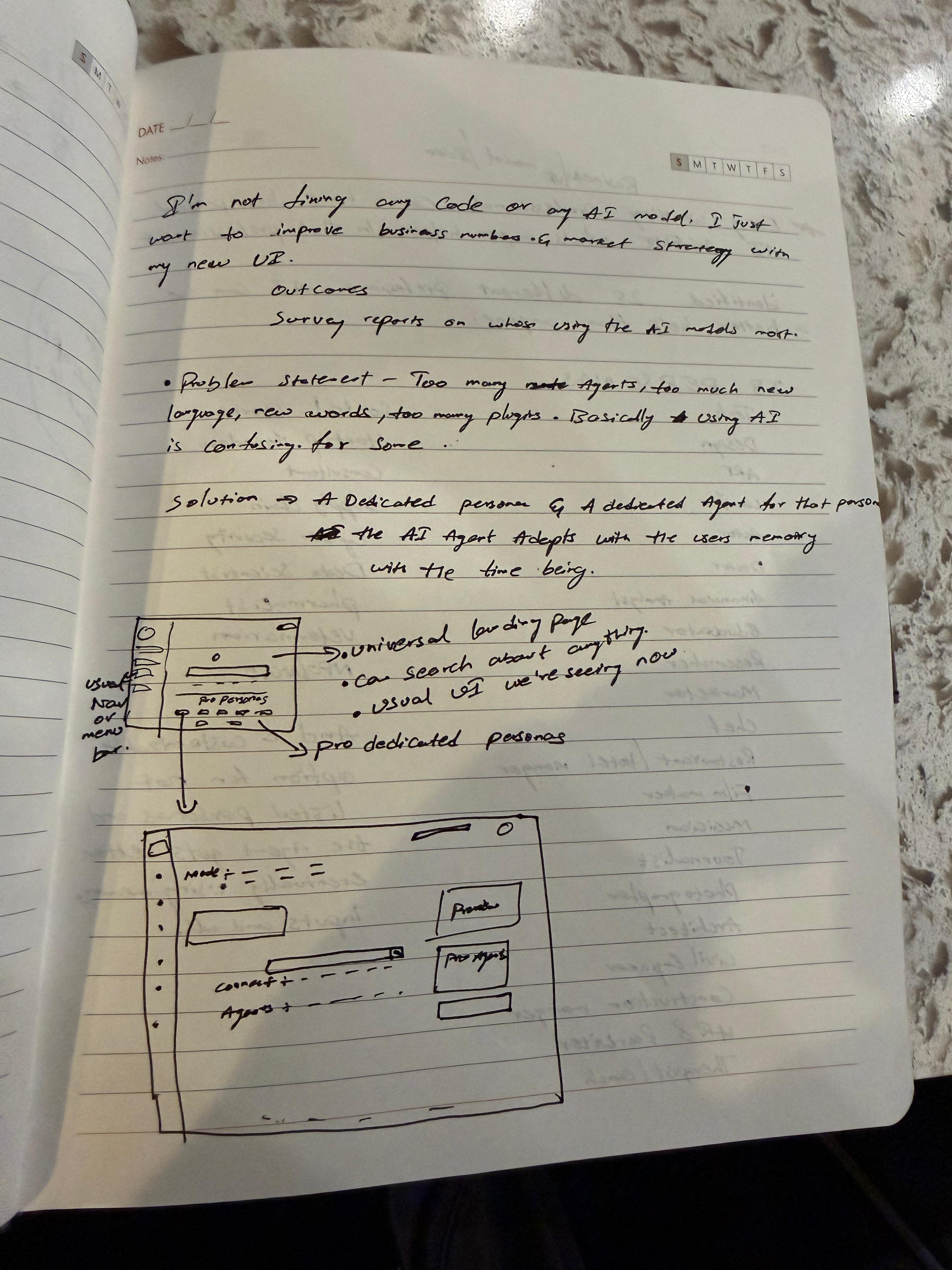
"Solution → A dedicated persona & a dedicated agent for that persona. The AI agent adapts with the user's memory over time."
73%
of knowledge workers say AI feels generic for their role
12
professionals interviewed across 6 domains
Research
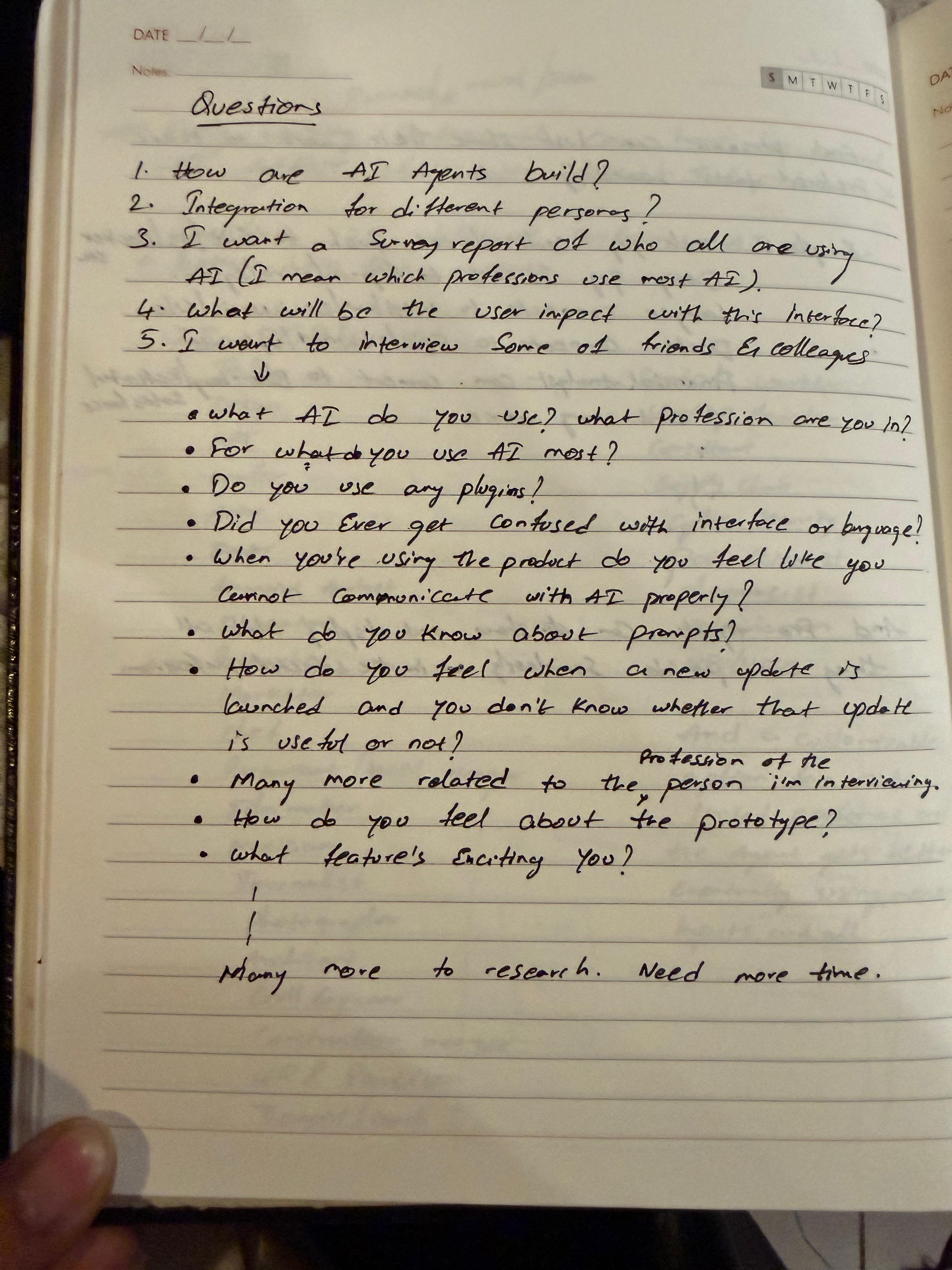
12 questions. 12 professionals. 6 domains.
Every idea was handwritten before a single line of code. I interviewed friends and colleagues across professions — engineers, designers, lawyers, doctors, analysts, educators — to understand how AI fails them today.
Q1
Usage
What AI tools do you use regularly?
Q2
Context
What is your profession and daily workflow?
Q3
Usage
For what tasks do you use AI most often?
Q4
Plugins
Do you use plugins, agents, or custom GPTs?
Q5
Pain
Have you ever felt confused by the AI interface or its language?
Q6
Pain
When you open AI, do you feel it truly understands your profession?
Q7
Pain
Do you feel you can't communicate with AI properly for your work?
Q8
Literacy
What do you know about prompts? Do you use them?
Q9
Trust
How do you feel when a new update launches and you don't know if it's relevant?
Q10
Vision
What would an ideal AI look like for your specific role?
Q11
Prototype
How did you feel using the D.AI prototype?
Q12
Prototype
Which feature excited you most — and why?
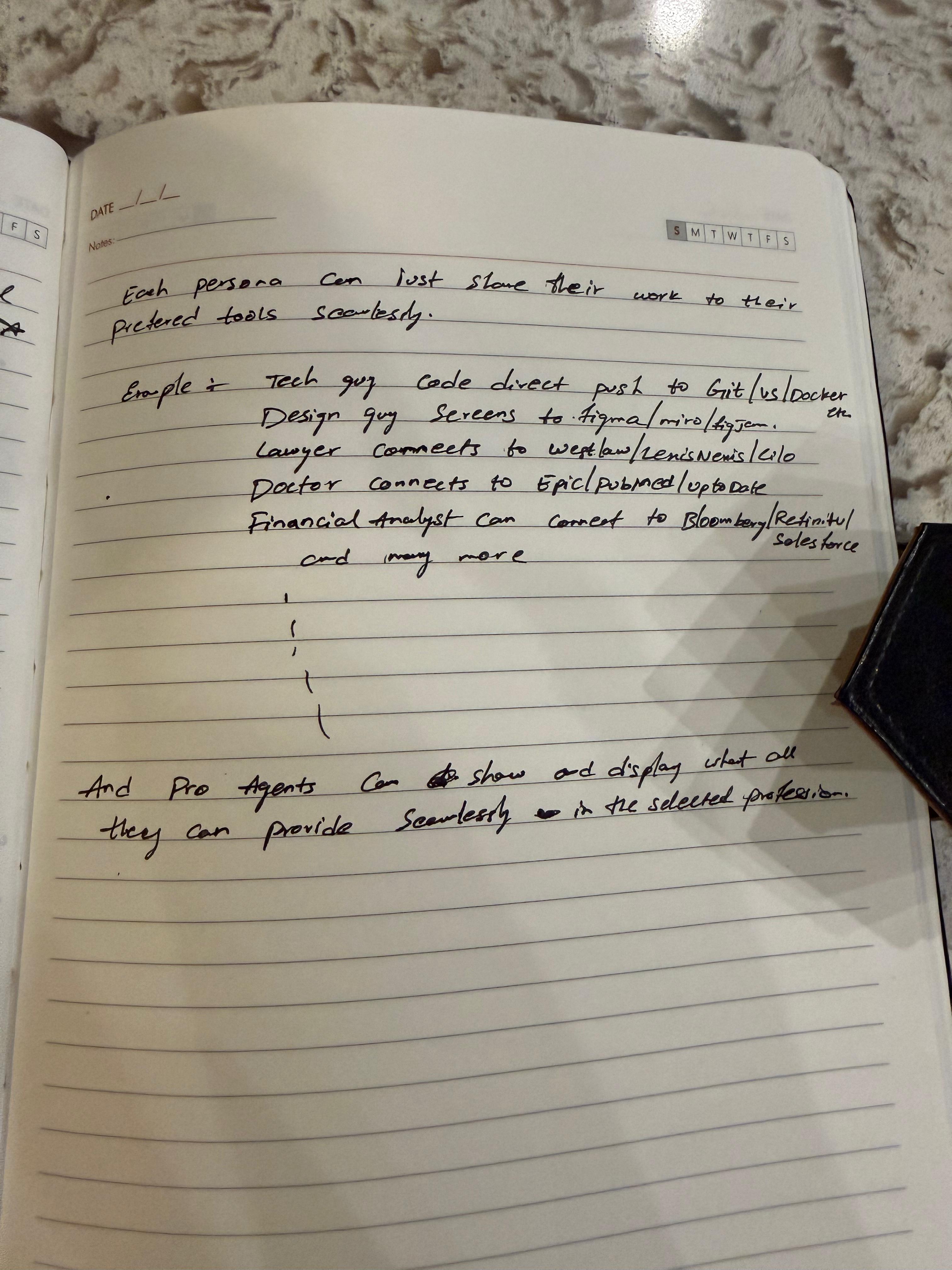
The notebook that started everything.
Mapped the full user journey, integration architecture, persona list, and feature set — all by hand before any prototype was built.
Page 1 · Problem & Solution
Page 2 · Personas & Business Model
Page 3 · Contextual Integrations
Page 4 · Interview Questions
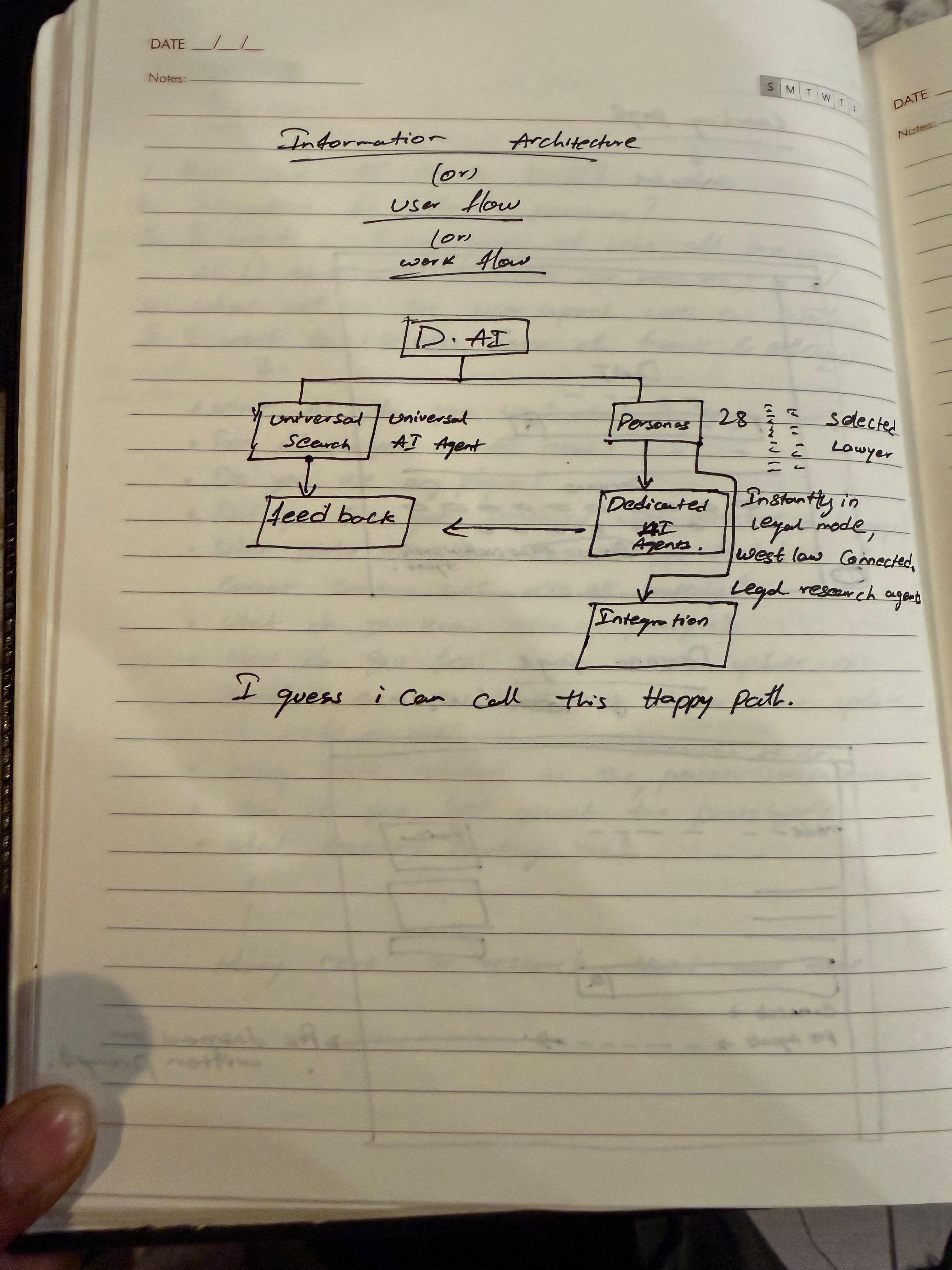
Page 5 · Information Architecture
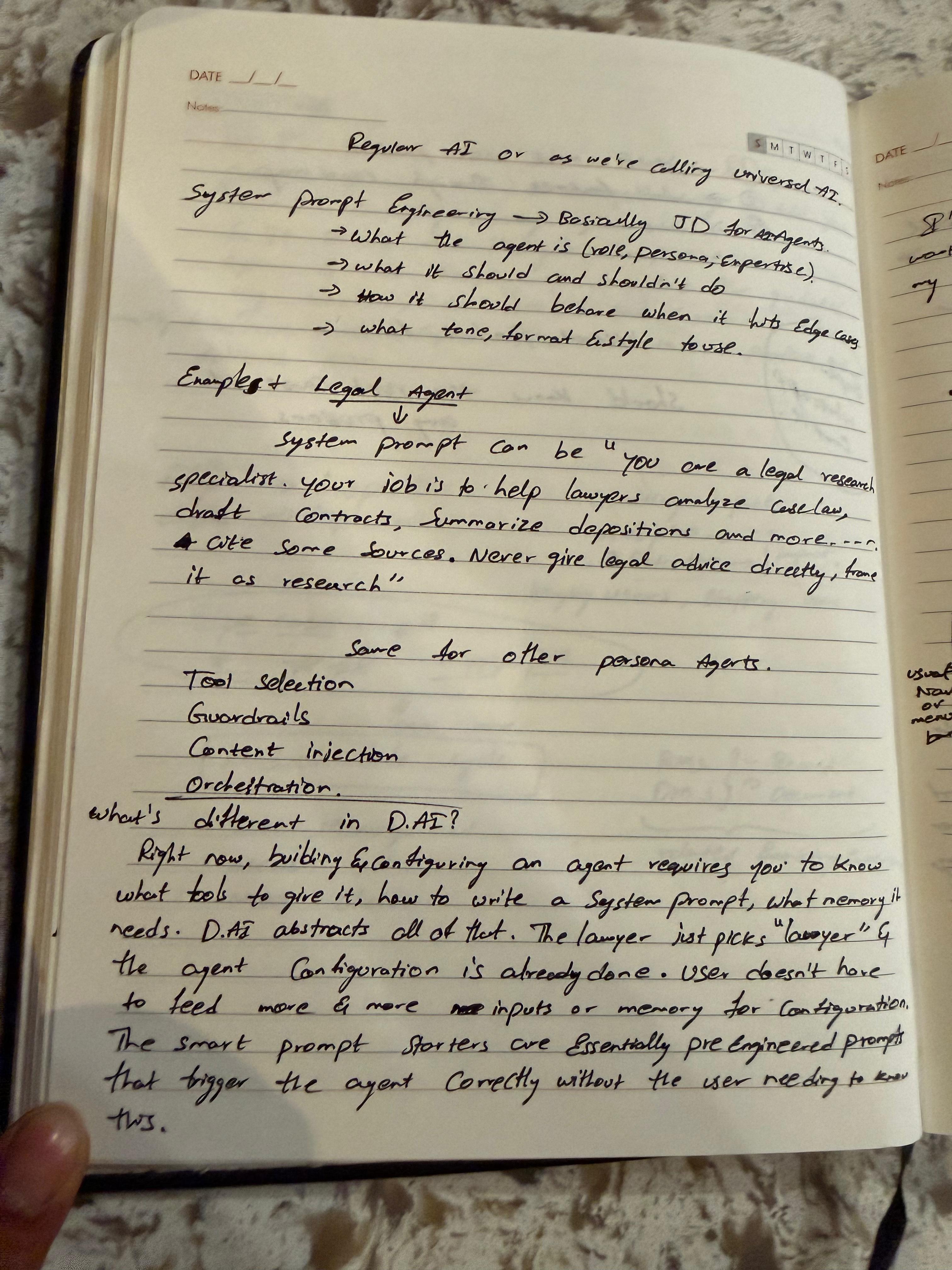
Page 6 · Technical Research
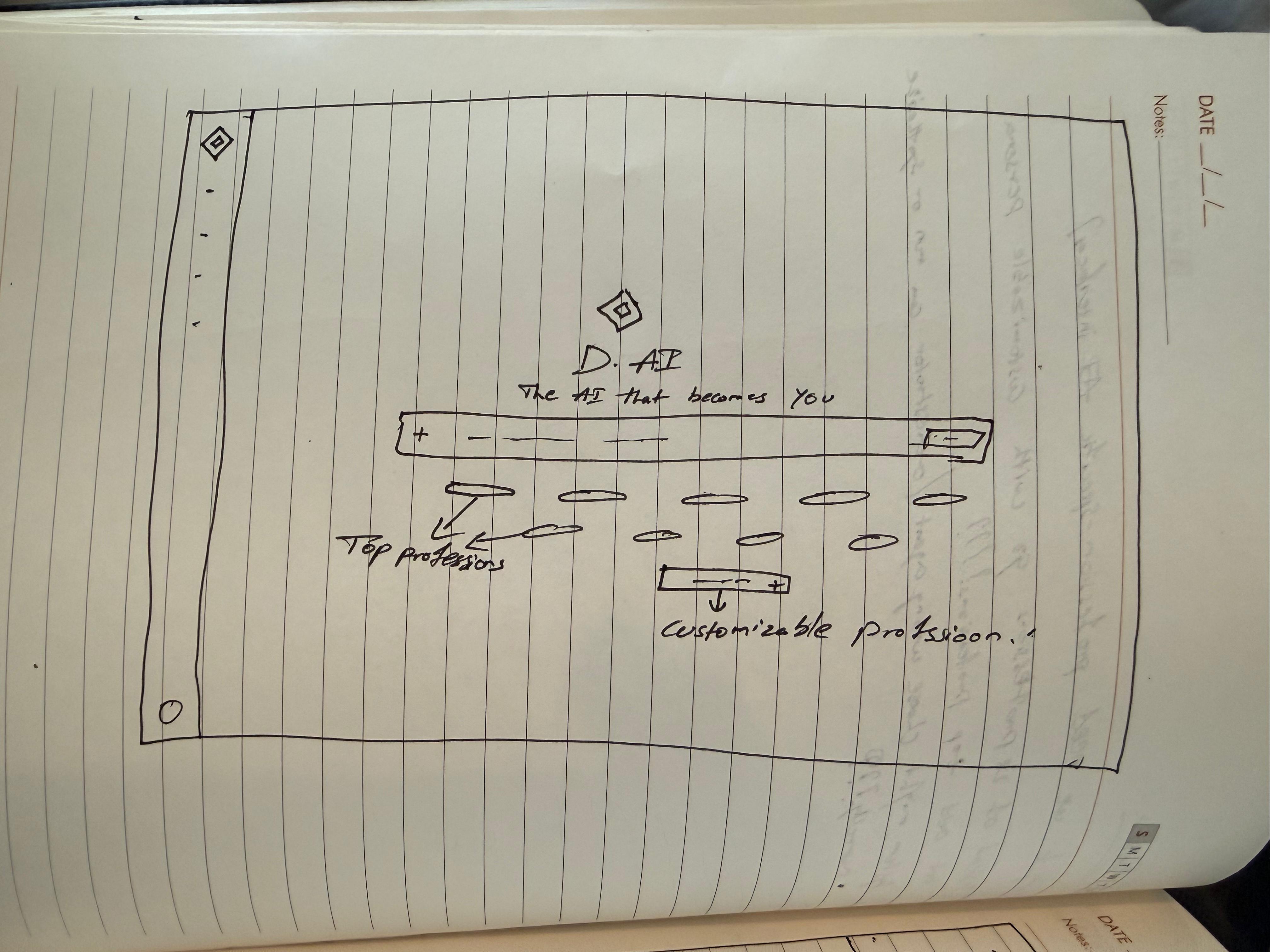
Page 7 · Wireframes
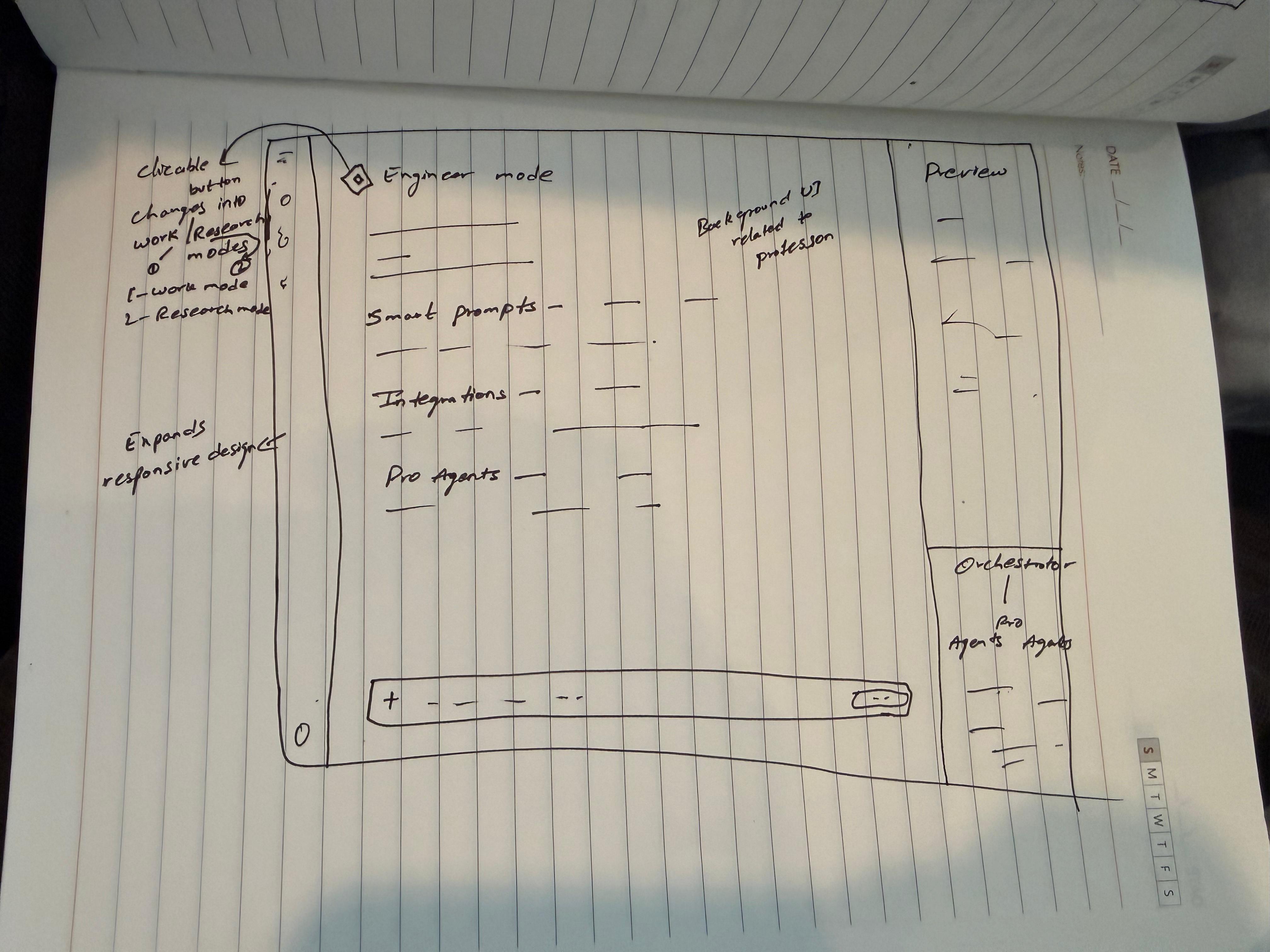
Page 8 · Wireframes
Information Architecture
The happy path.
"I guess I can call this Happy Path."
— Notebook, Page 6
◈
Entry
D.AI Landing
Universal search bar. Clean & minimal.
→
🔍
Universal
Search + AI Agent
Ask anything, any topic. Works like a standard AI chatbot.
→
◉
Select
Persona
Choose a top profession or type any role. Entire UI transforms instantly.
→
⚡
Transform
Dedicated AI Agents
Pro agents, smart prompts, tools — all pre-configured.
No plugin hunting. The tools an engineer actually uses are pre-connected and ready.
03
Smart Prompts surface engineering-specific tasks
"Review this PR for bugs," "Write Jest tests," "Explain this stack trace" — no blank slate.
04
User runs the Code Review agent
Clicks "Review this PR for memory leaks" — a pre-engineered prompt that triggers the right agent.
05
Orchestrator dispatches sub-agents in parallel
Memory Profiler scans for leaks. Code Analyzer checks patterns. Fix Suggester drafts solutions. All at once.
06
D.AI returns a structured code review
"Found 2 issues in allocFn() — memory not freed on error path. Lines 84 & 102. Recommend try/finally." One synthesized answer from multiple agents.
Total time: seconds
From persona selection to structured output — no prompt engineering, no plugin configuration, no agent setup. The user typed nothing. They clicked twice.
Before / After
The blank slate problem — solved.
"Pre designed or written prompts."
— Wireframe sketch, Page 5
Before · Generic AI
Ask anything...
Ask anything...
✗ User opens interface
✗ Stares at blank input box
✗ Struggles to phrase a prompt
✗ Types, deletes, rephrases twice
✗ Gets a mediocre answer
→
After · D.AI Engineer Persona
What will you build today?
+ Ask anything or pick a smart prompt ↓
Code Review
Debug AI
Doc Writer
Test Gen
✦ Review this PR for bugs
✦ Write unit tests for this module
✦ Explain this stack trace
✦ Draft a tech spec
Smart Prompt Starters
Every profession gets prompts that speak its language.
{ } Software Engineer
Review this PR for memory leaks
Write Jest tests for this module
Explain this stack trace
Draft RFC for this API endpoint
⚖ Corporate Lawyer
Draft NDA for SaaS partnership
Review liability clauses here
Summarize this deposition
Flag GDPR risks in this doc
◉ Product Manager
Write a PRD for this feature
Prioritize this backlog
Draft OKRs for Q3
Summarize user research notes
✚ Physician
Summarize this clinical study
Check drug interaction risk
Draft patient discharge note
Review differential diagnosis
Contextual Integrations
Each persona connects to the tools they already use.
"Tech guy → code direct push to Git/Docker. Design guy → screens to Figma/Miro. Lawyer → connects to Westlaw/LexisNexis."
— Notebook, Page 3
{ } Software Engineer
GitHub
Vercel
Jira
Docker
GitLab
◈ Designer
Figma
Miro
FigJam
Loom
Zeplin
⚖ Corporate Lawyer
Westlaw
LexisNexis
Clio
DocuSign
Relativity
✚ Physician
Epic
PubMed
UpToDate
Doximity
Athena
◉ Financial Analyst
Bloomberg
Refinitiv
Salesforce
Tableau
QuickBooks
UI Design — Screens
Universal landing. Persona transformation. Browse all.
d.ai
D.AI
+
What can I help you with today?
Popular Personas
⌨
◇
✚
§
◎
♨
△
✎
Explore more professions →
Type any profession...
Generate ✦
Landing Page
d.ai/engineer
What will you build today?
Pro Agents
◉ Code Review
◉ Debug AI
◉ Doc Writer
◉ Test Gen
✦ Smart Prompts NEW
Review this PR for bugs
Write unit tests
Explain stack trace
Draft a tech spec
Integrations
GitHub
Vercel
Jira
Figma
Slack
+
Ask anything or pick a smart prompt ↓
Live Preview
Review this PR for memory leaks
Found 2 issues in allocFn() — memory not freed on error path. Line 84 & 102.
✦
500M+ lines of production code trained
Orchestration
Request → Intent → Dispatch → Synthesize
Intent→Decompose→Dispatch→Synthesize
Active Agents
Code Review
Debug AI
Doc Writer
Test Gen
Switch Persona
◇
✚
§
◎
+
◈ Universal Search
Persona Page — Engineer
d.ai — browse all
Choose Your Profession
✕
Technology
Tech / Engineer
Data Scientist
Cyber Security
Civil Engineer
Creative
Designer
Photographer
Film Maker
Musician
Architect
Art
Professional Services
Lawyer
Financial Analyst
Consultant
Marketer
HR & Recruiter
Startup Founder
Healthcare & Science
Doctor
Pharmacist
Veterinarian
Researcher
Therapist / Coach
Operations
Supply Chain
Construction Mgr
Restaurant / Hotel Mgr
Chef
Impact
Educator
Journalist
Social Worker
NPO / NGO
Type any profession...
Generate with AI ✦
Explore Professions
Agentic AI — Technical Architecture
The technical reality behind D.AI's personas.
Each persona in D.AI is a pre-configured AI agent. Here is exactly what that means under the hood:
"Basically a JD for AI agents — what the agent is (role, persona, expertise), what it should & shouldn't do, how it behaves at edge cases, what tone, format & style to use."
— Notebook, Page 7 · System Prompt Engineering
🧠
01
The Model (Brain)
D.AI's model powers reasoning. Reads the situation, decides what to do next at every step.
→
🔧
02
Tools (Hands)
Without tools, models only generate text. Tools let agents act — search, code exec, API calls.
→
💾
03
Memory
In-context window, external database, episodic history. Agents remember across steps.
→
🔄
04
The Loop (ReAct)
Observe → Reason → Act → Repeat. Agents loop until the goal is done.
You select a profession — Lawyer, Engineer, Doctor...
02
System prompt loads silently — role + expertise + guardrails pre-written
03
Tools are pre-assigned — Westlaw for lawyers, GitHub for devs
04
Memory is pre-configured — no user setup required
05
Smart Prompts appear — pre-engineered triggers, ready to click
"Building & configuring an agent requires knowing what tools to give it, how to write a system prompt, what memory it needs. D.AI abstracts all of that. The lawyer just picks 'Lawyer' and it's done."
Multi-Agent Orchestration
One goal. Many agents. One answer.
When you send a request, D.AI's Orchestrator reads intent, decomposes the task into subtasks, and dispatches specialist agents in parallel. They report independently. It synthesizes one clean answer.
Risk Flagging · Compliance AI · Contract AI — all run at once. No sequential blocking.
03
Each agent reports independently
Results returned to Orchestrator. It reads all outputs, resolves conflicts.
04
Synthesized answer delivered
One unified response: risks ranked, gaps listed, redlines ready.
Risk Flagging
Scans 47 clauses for liability exposure
→ 4 high-risk: §7.2 §11 §14 §19
Compliance AI
Cross-refs GDPR & CCPA requirements
→ 3 compliance gaps found
Contract AI
Drafts suggested redline edits
→ 7 redlines with rationale
Synthesized Response
4 high-risk clauses · 3 compliance gaps · 7 redlines ready for download. D.AI makes this invisible — one click → parallel agents → one synthesized answer.
How the Orchestrator decides.
Not a router — a reasoner. The user just types. The Orchestrator autonomously reads intent, decomposes the task, selects agents, decides parallel vs. sequential, and synthesizes one answer.
01
Intent Classification
Simple Q? → direct answer. Complex multi-part? → decompose.
→
02
Task Decomposition
Breaks goal into discrete subtasks. Maps each to an agent.
→
03
Parallel vs. Sequential
Independent → fire all at once. Dependent → chain them.
→
04
Agent Selection
Matches subtasks to available agents for this persona.
→
05
Synthesis
Reads all outputs. Resolves conflicts. Structures by priority.
Competitive Differentiation
Not a better chatbot. A different product category.
Dimension
Generic AI Tools
D.AI
Interface
Same for everyone
Transforms per profession — color, font, layout, tone
Agents
User picks from a list or builds from scratch
Orchestrator decides autonomously based on task
Prompts
Start from blank input
Pre-engineered Smart Prompt Starters per profession
"Agent gets better eventually using memory, inputs and all."
— Notebook, Page 2
Free
$0
3 personas
Basic smart prompts
Standard agents
Community integrations
Pro
$**/mo
All professional personas
Smart Prompt Starters
Full Pro Agents suite
Priority integrations
Custom persona generator
Team
$**/seat
Everything in Pro
Shared prompt libraries
Team workspace
Admin dashboard
SSO + audit logs
Enterprise
Custom
White-label UI
Custom model routing
Multi-agent orchestration
Full API access
SLA guarantee
Design Thinking
This is how I think.
I start with the real person, not the feature.
Before any pixel — who is overwhelmed and why? The insight came from observing how AI tools treat a doctor and a developer identically.
I think in systems, not screens.
D.AI is an identity layer, not a theme switcher. The persona engine, the agent model, the integration logic — designed as a coherent system from the notebook up.
I build to validate, not to present.
A working React prototype with live API calls, fully-realized personas, and a custom AI generator — because you earn the right to pitch by building first.
I design for the industry I want to work in.
AI interfaces are the defining UX challenge of this decade. D.AI is my proof that I understand the space — technically, strategically, and visually.
the ai that becomes you.
Built from a blank notebook page to a working product.
Problem → Research → Architecture → Prototype → Impact.